'These Things of Darkness'; Dracula and Frankenstein as Gothic Capitalist Production
Added 2023-10-25 14:56:45 +0000 UTC“This thing of darkness I acknowledge mine” - The Tempest
Adaptation, Culture, and Production
Dracula, the novel, and Frankenstein, the novel, have one thing in common: they’re unfilmable. The books are unfilmable for different reasons. It boils down to this: Dracula is too bad to film, and Frankenstein is too good. As the reader will probably know, both of these unfilmable novels have been filmed. A lot. Indeed, they are among the two most filmed novels ever written.
To unpack a little… Dracula is based on feelings that are unexpressed and inexpressible without ruining the power of the book, which lies precisely in the non-expression of the feelings in question. Frankenstein is also based on such unexpressed and inexpressible feelings, but is a record of such feelings being intellectually and emotionally grappled with, fused with ideas, and turned into a complex set of interactions between the unconscious and the conscious, the emotional and the intellectual, the personal and the political, etc. That is the Frankenstein’s power. That is why, in order to be turned into a 20th century legend – i.e. a film – it had to be simplified down to base components, and thus rewritten into a different shape. Dracula’s power, by contrast, lies in its very lack of such complex interplay, any such attempt to comprehend and intellectualise, or even to consciously express, the emotions it is based on. Its power lies in its very artlessness. That is why, when turned into a 20th century myth – i.e. a film – it was rewritten into various versions of the same shape.
Dracula, in the movies, for all that it is usually replotted and de-populated (of necessity, given its flabbiness), retains the basic shape of the novel: an immortal, undead, blood-drinking nobleman from Somewhere Else encroaches on the middle class stability of Civilised Here, bringing all manner of threatening implications and changes with him. Frankenstein is far more radically changed in the movies. The big and essential Frankenstein adaptations are not actually adaptations of Frankenstein, at least not in any normal sense; rather they are new stories with some of the names from the old book stuck on them. They bear only slightly more relationship to the novel Frankenstein than The Day The Earth Stood Still does to the Gospels.
The two books lie at opposite ends of the Romantic project. Frankenstein at the opening, when Romanticism was still a phenomenon of the Enlightenment; Dracula at its close, when Romanticism was decaying deliciously into the Gothic, and thus into Modernism – which is profoundly decadent and insane, despite its telling insistence on the new and the clean.
Frankenstein – while utterly irrational – is constructed as a rational attempt to contain, utilise, comprehend, even tame the irrational. That it is unsuccessful is simply a testimony to the intensity of its irrationality. That it still fascinates is simply a testimony to the near-triumph of the attempt. The brilliancy of the book lies in this utter incompatibility at its heart, in the strength of its internal contradictions. It is the spirit of its age.
Dracula is a product of the end of this age. It makes no attempt to rationally contain any of its irrationality, because it is so profoundly irrational that it cannot even begin to conceptualise the extent of its irrationality, or even that it is irrational at all.
Frankenstein is irrationality rationally trying to rationalise itself. Dracula is irrationality so irrational it thinks itself rational. Thus, for all Frankenstein’s superiority, it is Dracula that speaks most directly and profoundly to the Modernity that followed it.
Frankenstein is a Modern book – it even has the word ‘Modern’ in its subtitle – yet it is an emanation of that early part of Modernity which still, because of its closeness to the pre-Modern, and thus its position at a point of unfixedness, held out hope for versions of the Modern which never came to pass. Indeed, Shelly would spend much of the rest of her career as a writer documenting the closure of the open futures she still believed in in Frankenstein. The conscious message of the book is that the Modern lies open before us and we fail it at our peril. Dracula is from a point after this failure has taken place. It is, consequently, far more optimistic about the Modern than Frankenstein. In Dracula, the Modern will save itself from its only enemies, which can come only from the past. Dracula is profoundly unconscious of the despair it truly feels at the Modern, which it secretly knows – without understanding – to be rotten from within.
Despite being often filmed, these novels remain unfilmable. Neither has actually been filmed at all – at least not in the sense of being faithfully represented. Both books have had at least one adaptation that is reasonably close to the source material in terms of structure, events, and characters. (Famous as a story always drastically altered in adaptation, Dracula has three – arguably four – adaptations that are fairly close in a literal sense; Frankenstein has one.) Yet neither book has ever been filmed in the sense of having its actual themes – which is another way of saying its ideology – put on screen.
Form and content being as entangled at they are, it is open to dispute whether it is ever actually possible to adapt any novel in that sense, or indeed at all. Even so, we tend to see – rightly or wrongly – most adaptations as having the themes of their source material transmitted into them by default, simply by virtue of the fact that retelling the story replicates the themes. This is nonsense, of course, what with the medium being the message and so on. (Frankenstein’s monster, already a cyborg in the films, has an equally mechanical bride.) And Dracula and Frankenstein illustrate this very well. They might even be the quintessential examples – apart from the Bible, or the The Communist Manifesto.
It is widely assumed that the films all express something essential in the books, yet this is barely true of any of them. There is a strange circular effect wherein the prevalence of adaptations convinces millions that they have read books they haven’t read, and that they therefore understand the themes of those books, and that therefore when the themes of the adaptations match the themes they know about, this proves the faithfulness of the adaptations. But the knowledge against which we tend to measure adaptations is of adaptations, not of their source. So we gauge the faithfulness of adaptations to one another, not to their source. In truly Benjaminian style, we are lost in a system of copies. It is even possible that the writers and directors of the adaptations sometimes work from inside this circle. It is arguable that original novels are themselves, in a sense, adaptations. We know about Barthes. (It’s worth remembering, when we bring up Barthes, that the ‘Death of the Author’ is a leftist idea, and also an inherently Gothic one.) A great deal of genetic material from disparate sources ended up in Dracula as it was assembled from disparate parts. There is a case for saying that every ‘original’ is the latest covert adaptation of various previous ‘originals’, themselves adaptations by extension. This is a notion which goes beyond the ‘anxiety of influence’ to question the very idea, not of influence (which is easily questionable), but of anxiety. In what sense can it meaningfully be anxiety at all when it is an integral, inherent, structural aspect of the process?
We tend to imagine, because Dracula films are about certain things, that the novel Dracula is about the same things. The same happens with Frankenstein/Frankenstein. The common conception of the themes of Frankenstein is something about the dangers of ‘playing god’ or, to put it less moralistically, the perils inherent in science. Dracula movies are not adaptations of the book at all but rather adaptations of adaptations, or of the cultural idea generated by the adaptations. This is not to discount them. Indeed, in a larger sense, what could be a more profound adaptation of a book than an adaptation of a culture’s idea of that book, regardless of its content? A text is one thing; a book is another. A text is a more-or-less discrete blob of words with a material history. It is directly produced. A ‘book’ is a cultural phenomenon. Its production is attenuated throughout time and space, social and psychological and cultural. The two - book and text - are obviously intimately related, but they are not the same thing. But nor can it be said that the text can ever be just itself. In order to be ‘active’, to have meaning, it must be socially activated. It must be read. And as soon as it is read, it is understood, conceptualised, interpreted. It is adapted. The process of filming it is just the process of its social activation, literalised, reified… commodified, in other words. That is not a reduction. Commodification, and thus reification, is simply how things are socially active in capitalist society. There is no meaningful sense in which a ‘book’ can exist outside its social and public existence, its having-been-read-ness, its adaptedness, its enculturation - and thus, in capitalism, its reification. This cuts to the core of any Marxist understanding of art, since it both focuses on and, in the same moment, extends, the moment and circumstances of production. Without deducting any importance from the economic moment of production - and thus of the extraction of surplus value from the wage labourer - it also adds importance, through the prism of the concept of production, to the rest of the process of dialectical cultural circulation.
The process of adapting a book into a film is thus not an artificial thing ‘on top of’ or outside the text. It is a literalisation, a crystallisation of its social activation and circulation. It is, for those texts to which it happens, an integral and inextricable part of it as a phenomenon, as an instance of production. After the adaptation, the book is not what it was before. It becomes part of a system of itself which now includes the adaptation or adaptations, and all the ‘distortions’ of the original which these include. The ideological meaning of the adaptation becomes part of the ideological meaning of the original text by a kind of retroactive causation. Dracula, the book, therefore is about all the things the films are about, all the things we think it is about – even when those things are not in the text. Or, to put it another way, they are in the text now – because we have put them there.
The Strange Case of Dr Jekyll and Mr Hyde is, amongst other things, a story about the unsustainability of pure moral categories. Hollywood turned it into a story about their viability, and the inherent superiority of some – those it associates with the white middle class, and thus with civilization and progress – over others. In doing so, Hollywood is not so much travestying the book as faithfully adapting the adaptation of the book created by the society which embraced it. Initially treated as something akin to toxic waste, the book was soon adopted by Victorian Britain after her ideological managers had transformed it into a moral homily about the need for private middle class virtue to match public middle class virtue. It had to be virtue all the way down. The book was adapted by the society it was released into. It was made fit for pulpits. This was how Victorian British society assimilated and processed stories which made it uneasy, including real stories. And we haven’t changed that much – indeed, part of why we’re still fascinated by Victoriana is because it looks like a heightened, distilled version of us, of modernity.
‘Jack the Ripper’ – another fictional story, in this case one written by newspapers which were ‘adapting’ a real series of murders – was also so processed. Indeed, in being processed, these two stories became inextricably linked. (And, with Dracula too.) People imagined the Whitechapel Murderer as a respectable West End gentleman by day, a killer of East End women by night. The opposition between the two Ends - the East and the West - is key to the social processing of the story of the five murders which occurred in the Autumn of 1888. Both the right and the left made it a story about this opposition in their different ways, whether they imagined it as a story about villainous and penurious East End (((foreigners))) or villainous and plutocratic West End swells. Either way, it became a story about something alien and predatory. Capital is viewable this way, but it ultimately has to be a metaphor about a system rather than a literal idea about actual people. To make it the latter rather than the former is to fatally misconstrue, and to lapse into the the anti-capitalism of fools, or the anti-capitalism of pro-capitalists.
The instability of our conception of the real duality in capitalism is reflected in the Gothic, which in its main narratives is intensely concerned with duality. Duality comes to be at the heart of the gothic. General social duality becomes privatised; individualised, gendered duality. At is easy to see where duality of self plays a role in the Werewolf and Jekyll/Hyde stories, but it is also deeply present in Dracula, and even in Frankenstein. Dracula is both a ravening monster and an aristocrat with whom one can converse. Frankenstein can be seen as a story of a divided self, with creator and creation as the two halves of one individual, the ‘monster’ being an attempt (as with Hyde) of creating a better self which becomes instead a dumping site for the self’s disavowed aspects. Hence the ambiguity about who the name ‘Frankenstein’ refers to. This ambiguity is not present in the book, but it arises naturally from it. This is the genre the book is in, and the ‘adapted’ version of the same genre it remains in today.
For our purposes here, the political orientations of the competing fantasies of ‘Jack the Ripper’ are not finally the point. They merely reflect the battle lines already drawn. The point here is the processing itself, the storification, the assimilation into a safely comprehensible pattern, the emptying of the ‘story’ of its actual content, which is to do with how Victorian capitalism both relied upon and generated savage class inequality, sharpened along lines of gender and race. This content transcends even the mainstream left commentary, which made the murders into the story of a moral failure to adequately address correctable imbalances. The ideological management is the point.
It is, however, also true that adaptation contains the original instabilities that made the adapted event or book work (the Gothic function being dysfunction). It contains those instabilities in two senses: the sense of having them within, and the sense of having them locked away. As much as the adaptations of these Gothic fever dreams might want to rid themselves of the instabilities at the heart of the Gothic, they cannot do so, because the entire point of their existence is to contain those instabilities. They must contain them in order to contain them – or attempt them. As a result, they must replicate, transmit, and perpetuate them in the course/cause of stopping their spread. The Gothic re-performs its own nightmare. It comes back from the dead. It infects those who try to stake it down. The Gothic performs the Gothic.
Reincarnation, Spectrality, the Gothic, and the Hauntological
It is interesting to note the ways in which the Dracula story has been adapted mirror the content of the adaptations themselves. One of the occasional but significant themes in adaptations is reincarnation. Cinema Dracula is wrapped up in reincarnation in various ways. He is reincarnated in different versions in different films. The Hammer Dracula (Christopher Lee) enjoys an eventful afterlife of perpetually cycling through destruction, reconstitution, brief periods of wreaking havoc, and then being destroyed again. In several adaptations, Dracula is after Mina (or Lucy… the female names in the adaptations are generally interchangeable) because she is the reincarnation of his lost love.
Dracula, as with all vampires, is arguably the reincarnation – in the literal sense of being put back into meat – of an evil spirit. The exact relationship of the person Dracula to the spirit of the vampire Dracula is one of the things the various adaptations obsessively consider. The Hammer Dracula is a fragile thing, constantly disintegrating and needing to be reincorporated via infusions of fresh corporeal matter. Dracula is a story about bodies, about the supposed casing of spirits, souls, consciousnesses, and/or vital sparks, inside cases of blood, flesh, and bone. It is a deeply Cartesian story. And this is seen in the difficulty we have categorizing Dracula, or vampires generally. They fit into the Gothic as much by tradition (i.e. habit) as much as by any other logic. It is true that they are constituted partly of some quintessentially Gothic themes: the re-irruption of the dead and buried, literally or metaphorically, etc. And yet they are only partly ghostly in the same of being spectral or phantasmic. They can inhabit the non-physical realm, but apparently only briefly, for pragmatic purposes. Their essential nature is embodiment. Their essential activity is physical. They do not pass through us. They puncture us.
The vampire stories of early-to-mid 20th century are often seen as exemplars of the older tradition that was rejected by late 20th century Horror when it turned to the physical, the material, the idea of humans as meat. But they are at least as much the presagers of this. Hammer was making The Texas Chainsaw Massacre and Dawn of the Dead possible when it opened its first Dracula film with surrealistically bright crimson liquid dripping onto a tomb. We must disentangle the Gothic from the Hauntological. In so doing we will see that the Hauntological has a complex relationship with the spectral. Even the traditional ghost – and that creature is very much an outlier once we reach modernity – is imagined wearing its shroud, rattling chains, etc. The ghost of Hamlet’s father must flee the crowing of the cock to rejoin the physical torments of Purgatory.
As Franco Moretti put it – as usual, getting at something important and true, and also getting it slightly but crucially wrong in the process – Dracula “in fact he has no body — or rather, he has no shadow. His body admittedly exists, but it is ‘incorporeal’ — ‘sensibly supersensible’ — as Marx wrote of the commodity, ‘impossible as a physical fact’”
The Vampire as Capital; the Monster as Proletariat
Every hack tasked with writing some bit of Dracula fluff will employ some variant of the obvious and banal remark that “the Count will never lie down”. But obvious banalities sometimes bear investigation.
It would be just as obvious and banal to liken the spread of Dracula around the world and throughout culture to the exponential, viral expansion of vampirism that would ensue if vampires were actually real. It would be no more than stating the fact that Dracula is a successful commodity or brand. That is what successful commodities or brands do. They reproduce, seemingly without human input and out of human control, to the point of threatening people. They seem to do this despite the fact that their reproduction is actually a result of human production. As with vampires, commodities are reproduced by the parasitism upon, and negation of, the human subject. Capital is the vampire battening on us, as Marx saw. At this point, this itself - at least in the context of Gothic studies - is a banality. Yet the subjugation of human life to just such banalities, just such spectral abstractions, is the core of Marx’s complaint. Commodity production, through its alien organisation of human time, hollows people out. Capital expands as humanity shrinks. The similarity between the viral commodity and Dracula is a tautology, since it has been so successful precisely because it expresses the underlying mechanism of its own success.
Dracula and Frankenstein, the two quintessential monsters of Gothic mass culture in the 20th Century, are inextricably linked. They are two nodes of one dialectic; mutually dependant. But, in the way of these things, they are also inherently separate and antagonistic. About the only thing they have in common is their moment of conception.
As David McNally pointed out in Monsters of the Market, both figures were conceived in the course of a single night in 1816, during which Mary Shelley became heavy with Frankenstein and Lord Byron with Dracula. It is tempting to look at the evening as a copulation between these two, from which both came away pregnant. Dracula, it is true, gestated longer than Frankenstein. He was born almost immediately (in authorial time) whereas Dracula took longer. He was transplanted from Byron into Polidori, and then into Stoker, with much genetic material contributed along the way by Le Fanu and others. As noted, it was - ironically enough - Dracula who had to be assembled from the bits and pieces of other characters.
The already mentioned Franco Moretti – great Marxist critic and himself, it transpired, predatory monster – wrote a famous essay, ‘The Dialectic of Fear’ (published in New Left Review #136, Nov-Dec 1982), interpreting Dracula and Frankenstein as representing – to describe his argument crudely – bourgeoisie and proletariat. Frankenstein assembles his creature from many human parts, the parts of the dismembered poor, as the proletariat was constructed in the era of primitive accumulation, the forcible seizure and violent assimilation of feudal property into capital, during which the book was written. The creature is corporate, its individuality and selfhood the subjects of contestation. It is now called ‘Frankenstein’s Monster’ in the same way that a worker is said to be ‘a Ford worker’ (Moretti’s analogy). Its creator draws back from it in horror, recognising his future gravedigger in his own creation. It is feared that the creature will be the progenitor of a ‘new race’, a ‘race of devils’, much as the new global proletariat was constructed using new racial categories, and seen as a new and terrifying phenomenon that threatened to override the world by breeding too much, or by more consciously political means. As with the proletariat, and the subjugated racial categories contained within it, the monster is seen as both inferior and overwhelmingly powerful.
I have my issues with Moretti, besides his personal crimes. He uses the word ‘lies’ to describe Victor Frankenstein’s supposedly inaccurate descriptions of the monster as beautiful. But, firstly, we are confusing perception with reality. Victor perceives his construction as beautiful because he attempts to construct it according to implicitly classical notions of beauty. Remember that original (wonderful) woodcut by Von Holst which depicts the monster as a giganticised and jumbled reiteration of Michaelangelo’s newly-created Adam.
<figure>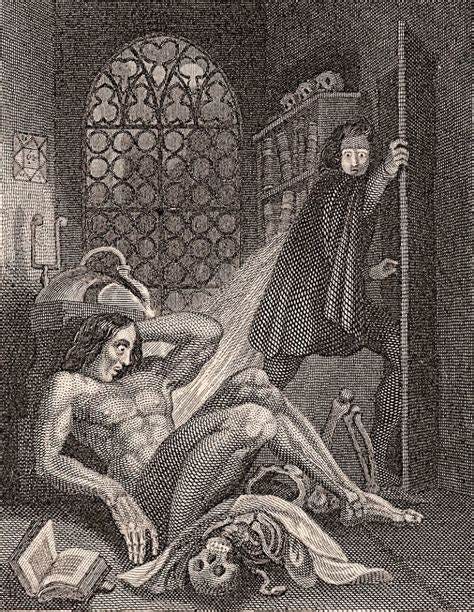 </figure>
But, as this woodcut shows, there is no guarantee that things that accord with classical notions of proportion will actually be beautiful. Rather, beauty is a concept we have mapped onto certain stereotypical physicalities which stem from a bastardized and historically re-written version of classicism, recast in terms of 18th and 19th century bourgeois prejudices. It is profoundly local – historically, geographically, socially and ideologically. It is implicitly tied in with notions of ‘health’ which stem from the privileged lives of the rich (smooth skin, for example), and which later get appropriated by reductionist Darwinian ideologies which link beauty with ‘fitness’… a set of notions still widely repeated by today’s biological determinists. It would be perfectly possible to construct something according to abstract classical (or pseudo-classical) notions of beauty that turned out hideous and terrifying to the beholder. Just imagine actually meeting Michaelangelo’s David in the street.
But this leads us to another issue. As stated, we’re talking about Victor’s perceptions. What seemed beautiful to him in conception, in theory, during construction, in isolated parts, could well seem ghastly in totality. Or perhaps the totality of the final creation simply brings home to Victor the ramifications of what he has done. He has created something which now has separate existence, separate power, autonomy and selfhood. When he looks at it as another person as opposed to a plan or a set of pieces to be assembled, he suddenly finds it frightening. This actually fits better with Moretti’s conception of the monster as a proletariat in singular, as terrifying because the creator perceives it as his potential gravedigger. Like many creators of actual proletarian populations, Victor the bourgeois looks at what he has created and, in place of the vast reservoir of ready and eager and docile and easily-exploited labour that he planned, he sees something terrifyingly dangerous precisely because of its autonomy.
This in turn leads to another issue. Moretti talks about the bourgeois conception of the lower orders as hideously unequal or inferior. He implies a relation between this (which found itself expressed in Darwinian reductionist narratives about degraded ‘types’ or ‘natural lower orders’) and between the racial narrative of capitalism. But, influenced as he was by psychoanalysis, he seems to be flailing about for a psychological rationale for racism as a response to the horror of the subjected object. But the process of ‘race making’, or ‘the construction of whiteness’, in which the bourgeois social order constructs the ideology of biological race (and thus of biological racism) as a justification for racially-ordered systems of labour exploitation, i.e. slavery and the slave trade, is a fair bit more material than that. Furthermore, the psychological aspect (which is definitely present) is based not on horror at the subject but on the need to confront a living subject and make it an object that is horrifying, and thus subjectable - to turn workers who are Black into ‘negro slaves’ for instance, from people who are being exploited into monsters who deserve no better. As Marx comments, it is only in the social context of capital that a ‘man of the black race’ becomes a ‘negro slave’.
Moretti misses the extent to which race is ideologically constructed, and the extent to which it thus filters into perceptions. He puts it the wrong way round, or seems to. Having constructed the ideology of racial orders, the system then creates consciousness in people which causes them to perceive racial difference that is not, as we now know, actually existing in nature. There are no ‘races’, and we construct them out of ideology. This, it seems to me, is actually directly mirrored in Victor’s sudden perception of his new creation as ugly. He looks at it and called it beautiful, then looks again and perceives it as ugly – which is to say, as Moretti points out, as racially ‘other’. And the only change is a material one. The creature is now alive. He made it ugly because it came alive and its disavowal needed an ideological justification. Victor the bourgeois, in effect, ‘makes’ a race in two senses. He runs the risk of creating a ‘race of devils’ in the sense of creating a new breed among humans. But this is the diegetic sense that he, the character, perceives and believes. Beneath that, there is Victor as a textual reification of ideological manoeuvres. In that sense, what he’s actually doing is ‘race making’. He is superimposing an ideology of racial difference and hierarchy upon a ‘wretch’ that he deems inferior because it is both his slave and his potential gravedigger. Its status as a living thing makes this ideologically necessary. That other people perceive the monster in essentially the same way only speaks to the universality of the ideology of race once constructed. Moretti goes on to recognise something of the instability of some of those aforementioned bourgeois conceptions of beauty, and to bring in the artificiality of race, which is also a neat demonstration of the Marxian insight - internalised by Walter Benjamin and best championed today by Terry Eagleton - that progress and barbarism are forever intertwined, to the extent that they are essentially the same thing viewed from different angles.
Mary Shelley became something of a reactionary in later life. Despite being a radical critique of the Enlightenment project and the dawning Industrial Revolution, Frankenstein is a book with more than a seed of the reactionary nestling within it. Like many from the early years of capitalism who disapproved of the new system in some measure, Shelley is in many respects essentially a conservative. Shakespeare, writing at the very dawn of the Early Modern Era, at the fulcrum of the transition from feudalism to capitalism, is highly critical of many aspects of the emergent bourgeois culture (along with being irresistibly attracted to them) but his criticism takes the form of an essentially conservative attachment to pre-bourgeois ideas of social obligation. Capitalism detaches pre-capitalist people from old and established ties of obligation which constitute the social structure of feudalism. He sympathises with shepherds leading newly precarious lives in the Forest of Arden after the enclosures, but he also worries about the fickleness of the new urban proles (so like the vicious Roman mob!) and so on. Timon rages at money the universal whore, the utterly faithless golden metaphor which, in the bourgeois system, breaks down all loyalties and moral certainties… and yet Shakespeare’s solution is for the classical virtues to be imposed by martial law in the person of Alcibiades. In the same way, Mary Shelley frets at the emergence of the new bourgeois product – so powerful, so autonomous – and the newly forming proletariat – so powerful, so autonomous – even as she rails at the failure of social justice contained within the new system. The book is a critique from a radical position but also from a privileged one. Shelley sees the ruthless failure of tolerance and compassion and social justice which is contained within these new phenomena. The Enlightenment project will fail if it is not cared for and nurtured, and justice is the most essential pre-requisite… and that justice is being denied. But, even as she rails at justice denied, she frets at the revenge of history. This is perfectly in line with the reservations of Mary’s father, Godwin, who wants reform through fireside chats with the educated, and her radical boyfriend-later-husband, Percy Shelley, who flip-flops back-and-forth between foaming revolutionism and elitist worrying about the ignorant mob. “Shelley, you are preparing a scene of blood,” warned Godwin when Percy became too agitational.
But, in some ways, Mary goes further. Frankenstein is almost a declaration that the entire project – not just reform but capitalism itself – is doomed to failure. This is not a categorical judgement. There are countervailing tendencies in this book and others she wrote. She was always profoundly ambivalent about Romanticism and the Enlightenment – something that makes her such a fascinating liminal figure in her milieu. But it seems that, for her, the monstrous nature of the products – be they machines or classes – dooms them to forever be denied justice and responsible use. Without the perspective of class struggle, she doesn’t see the possibility that the new class could remake the world. She does, however, see ‘the common ruination of the contending classes’. But she lived before capitalism had spread across the globe and taken over. To her, it’s not too late for the world to go back to how it was before, once those warring opposites kill each other. Frankenstein and the monster destroy each other. They both die without issue. The ‘race of devils’ is never spawned. As Moretti points out, Frankenstein has no way of utilising the creature because capital is erased from the picture. There are no factories for it and its kin to work in. It is never cconcieved of as productive, or as having utility. Mary Shelley turns the two men – and Capital and Labour – into a doomed fable. These days, the end of the world is now proverbially known to be easier to imagine than the end of capitalism. To Mary Shelley, it was decidedly the other way round.
Frankenstein is about the terrifying new creative forces unleashed by modernity. Says Shelley: the Enlightenment, if it is to ‘succeed’, must find a way to say of its new Calibans ‘these things of darkness we acknowledge ours’, and to mean it. Anything else will bring only that aforementioned common ruination. Shelley’s plea is for the Enlightenment project to embrace responsibility, even for its own awful products, be they machine or human, or both, or somewhere in between. Even as she makes her plea, she is pessimistic owing to the monstrous incommensurability of the products of modernity. To that extent, and to that extent only, the vulgar mainstream account of the book – that it is a cautionary tale of the dangers of scientific overreach – is correct. The book is about that new modern intersection between products (material and social) and producers, the line along which the two merge, with humans becoming commodities and commodities coming alive. The developed form of this would one day be described by Marx using the concept of ‘commodity fetishism’. Commodity fetishism, avant la lettre, is at the heart of the book’s pioneering version of the Dark Sublime. The awesome problem isn’t that Frankenstein plays God; it’s that the productive capacities of the modern world have rendered God obsolete.
Dracula, by contrast, is capital – as Marx anticipated when he repeatedly referred to capital as a vampire. Dracula, of course, lives – or rather exists, self-perpetuates – by just this kind of sucking, this exploitation of the living. Moreover, Dracula – according to Moretti – is not really an aristocrat. He lacks almost all markers of aristocracy, and instead seems far more like a bourgeois, or even like money itself – of which he has much lying around in hoarded piles. He is all about pragmatic exploitation rather than enjoyment. His immortality is a curse of eternal competition. He is driven to assimilate, use, expand, compete. He enjoys nothing. He ‘lives’ by an unholy version of the pragmatic ‘protestant ethic’ that – as we’ve seen in other essays – is crucial to capitalism as an expression of itself, an ideology, an organising logic.
But Dracula, according to Moretti, is also a particular type of capital: monopoly capital. This is shown in the threats he represents: the threat of exponential expansion leading to total control, total conversion and global domination. No more ‘fixed contracts’, ‘free trade’, ‘economic liberty’, etc. Instead, slavery to one pole of unchallengeable power. He is an emerging and rising form of global capitalism as seen from the petty bourgeois middle. He is opposed by Van Helsing, a Dutchman, a man from the (supposed) home of free trade. He is opposed by the supposedly moral people of libertarian capitalism, who understand that money must be used freely and virtuously, like Dickensian bourgeois benefactors of humanity. Individualism – and thus the bourgeois world – must be tempered with altruism, true religion, etc. It is the ultimate expression of bourgeois Victorian moralistic self-delusion; stemming – as every drop in the tidal wave of such stuff did – from anxiety.
In line with his essentially petty bourgeois anxiety about modernity, Stoker constructs Dracula from stereotypes about foreigners, Eastern Europeans, even Jews. Stoker’s rational English, American, and Dutch (i.e. Western) heroes – the jolly fine chaps whose camaraderie is what Stoker imagines to be the moral heart of the book – diagnose, categorize, typologize, and racially-profile Dracula. They employ prototypical social Darwinism, and something like phrenology. The shape and size of Dracula’s skull is gone into (always a bad sign). He is, they decide, essentially a criminal type, with a child’s brain. Primitive. Atavistic. Impertinent. Out of his proper time and place. An upstart savage. For all his noble heritage, it is only the noble heritage of the East.
It is very telling that the skull is a central emblem not only of the Gothic but also of scientific racism, and then of fascism. There is a sense in which these three are – to be schematic – in a line of progression, with each less healthy than the last. The Gothic is the anxious expression of ambivalence; an attempt to sublimate via an artistic expression of the failure of sublimation. Scientific racism is the attempt to sublimate the anxiety rationally. Fascism is the darkly joyous and wantonly irrational celebration of the failure of sublimation, coupled with an impudently dogmatic refusal to admit of the failure; modern civilisation engaging in a paradoxically puritanical dirty protest.
Dracula and Frankenstein have one very large element in common: paranoia about the rise of new races. One of the essential discourse of white supremacy is worry – panicked, resigned, whatever the inflection – about the idea that the white race is in decline, or its moment has passed, and it is about to be displaced by the other races. Formally resembling a morbid symptom of the decline of white supremacy, the anxiety is actually foundational to it. White supremacy was built on the idea that white supremacy was under threat. This was one of the key ideological narratives which helped bourgeois civilization build racial categories and hierarchies – much as reactionary politics is always based on a kind of salutary pessimism about the old ways being too weak and decadent to protect themselves. Race is a socially and historically constructed idea, and this had to be achieved ideologically in order to make capitalism work economically. Races had to be invented in order that they be placed on a hierarchy.
Like many people, Stoker’s anxiety about modernity is, at base, an anxiety about capitalism; not because he is against capitalism, but because capitalism is – unbeknown to him – the basis of the modernity he is anxious about. He is anxious about it because of the energies it releases rather than the energies it stifles. His is the anti-capitalism of fools, and also neurotics. At a base level, capitalism is the repressed that returns in his writing. This is precisely because, at a superstructural level, what he frets over are the opportunities for others, and even more worryingly for himself, that it opens. The opportunities we’re talking about are fundamentally sexual (as indeed is so much fascist discourse). But sex, as we are increasingly understanding, is not some primal force at the root of our nature. It does not determine our social being, any more than any other instinct that most people share. It is social, something we produce socially. Thus it is something which emanates from society, or rather from us in society, if only because it is very difficult for us to be anywhere else.
Prospero’s line from The Tempest, spoken about Caliban – “this thing of darkness I acknowledge mine” – is an acceptance both of responsibility and ownership. It is fatally ambiguous because it takes on social responsibility, but the social responsibility it takes on is the responsibility of an owner, a master. Post-colonial criticism of The Tempest makes Caliban a prefiguration of the colonial subject, etc. He is also a prefiguration of the monsters of modernity, of the gothic. He is Shakespeare’s first ‘monster’ in the true modern sense, appearing in one of Shakespeare’s last plays. He is thus an ancestor of Dracula and Frankenstein, and all the rest. And his role in the play is to represent that which is disavowed but also claimed and owned, subjugated but also threatening. Modernity, and thus inherently also colonialism, will depend upon this ambivalent feeling of ‘ownership’ over Caliban, over millions of Calibans, the ‘half devils and half children’ of Kipling, the “race of devils” Victor Frankenstein imagines spawning from his creation and its bride. Modernity, and thus inherently also capitalism, will depend upon this ambivalent feeling of ‘ownership’ over all these creations, these products, these living commodities. It is why we mass-produce stories about the things we make turning against us, the things we own destroying us. The mass-produced cultural myth of the monster strikes at the conflicted heart of modernity. It is the central narrative of modernity because it is the dramatisation of the nightmare world of the fetishised commodity. The proof is that it is endlessly adapted into commodity after commodity, spawning anew, reincarnating, biting and infecting anew, transmitting, invading, colonising, assimilating, radiating outward in an exponential expansion. This is the secret, accidental truth lurking within the hack’s phrase.
Comments
I just finished teaching Frankenstein and the students have voted on vampire texts for the rest of the term (although I am avoiding Dracula). Would it be alright to share this essay either in full or part with my students?
Emily Kugler
2023-11-07 05:45:20 +0000 UTC